

00:05:26 Rob
00:12:03 Bob,
Do you think Google favours crawling any type of content over the other, such as selecting a news page over a blog post? Or what Google looks for is the frequency of the new posts, no matter what kind of a page it is?
Rob 00:17:18
3. What is it mean that the page crawled but was not indexed from a human perspective?
00:18:50 Rob asks
4. What is a robot’s directive?
00:20:48 Rob
00:27:50 Rob
6. Haven’t we talked about the Schema yet? Does anybody have thoughts?
00:29:15 Rob
00:37:11 Rob
8. Do you have any additions you want to make or any tools you like to suggest?
Audience Questions
00:45:50 Question 1
1:00:30 Question 2
1:08:24 Question 3
00:05:45 Joshua Monge
This is Joshua’s 4 C method: Code, Content, Community and Competitors. Code is the part where the Technical SEO steps in. Having a clean code of your website and content without errors is the key to getting crawled and eventually indexed by Google.
00:06:55 Bob Clark
How accessible you make your content for the robot to crawl is essential because any content should be reachable within at most four clicks from the homepage. Otherwise, bots would not crawl deeper than four clicks because the Google bot has a specific crawl budget for each website. Putting your content too deep will end up Google Bot not crawling your content. As a result, your content cannot get indexed. Let’s give an example: You have a Food website. Your Category is breakfast food, and your subcategory is bread. Anything further down the bread is going to be tagged. This is very useful for not only the bots but also for the reader to find the content that they are looking for. This way of organizing your content also helps build up your authority.
00:08:50 Karin Tierney
Make sure you have a sitemap. Most content management tools such as WordPress or Shopify have built-in sitemap tools. Create your sitemap and give it to Google Search Console. Karin’s clients had no sitemap and got only nine visitors a month. When Karin has added a sitemap and submitted it to Google Search Console (GSM), her client started receiving 50 customers a month. This shows how important to have a sitemap.
A sitemap is like a table of contents for your website. You are documenting your links on topics and subtopics orderly for Robots to read, not visitors. This will help crawler robots to understand what your site is about. The sitemap file format is sitemap.xml
00:10:25 Joshua Monge
Search engines generally expect sitemaps at the root folder of your domain, such as https://www.domain.com/sitemap.xml. What this means is Google will crawl everything listed under your root domain. If you have a sitemap.xml file like: https://www.domain.com/mycategories/sitemap.xml, Google will only read anything under https://domain.com/mycategories/sitemap.xml. However, if you have content placed as https://www.domain.com/images, anything under the subcategory images would not be indexed. If you want to learn more about sitemap, please check out Google’s sitemap guide https://support.google.com/webmasters/answer/7451001?rd=2&visit_id=637754678629652011-2968956138#errors&zippy=%2Ccomplete-error-list
Another thing to be careful of is when you use https://www.domain.com/sitemap.xml for your sitemap.xml format, it’ll be easier for your competitors to discover your content and sitemap. When you generate your sitemap be more creative and use something like https://www.domain.com/my_sites_sitemap.xml
Also, check out Sitemap Protocols from https://www.sitemaps.org/protocol.html#location
00:11:20 Firuze Gokce
There are a couple of free tools to help you visualize your table of contents, in other words, your topics and subtopics, quickly. They allow you to put your content into a structure. One of the tools is called https://draw.ai/, and the other is https://miro.com
00:12:29 Rob Bertholf
Rob’s experience makes him focus on using a priority tag to tell the crawlers which pages have the highest priorities and which pages do not. When using a priority tag, your valid priority values must be between the 0.0 – 1.0 range. [0.0, 0.1, 0.2, 0.3, 0.4, 0.5, 0.6, 0.7, 0.8, 0.9, 1.0]. and the highest priority is set to 1.0 https://www.microsystools.com/products/sitemap-generator/help/xml-sitemap-priority-tag/
According to the Megaworx blog (https://www.mageworx.com/blog/common-myths-behind-site-crawling-indexation-sitemaps) Indexing frequency is not related to ranking.
Rob is advising to create an XML sitemap for every page type. For example, blog posts are one-page type; a category might be page type, guides, list of tags, taxonomies, or attributes could be a page type too. Why do we need this kind of detailed attention for sitemaps? It’ll be easier to break it down if you deal with larger websites like one of Rob’s clients, who has 3 million pages. Classify the pages in different silos and quickly find any error or problem.
00:15:40 Joshua Monge
Joshua thinks that sitemaps are providing clarity for the Search Engines. They are signalling to the Search Engines that a content list has been created. Having a sitemap does not necessarily mean that Google will index all the items in your sitemap. However, the best practice is to have an introductory sitemap for your website. If your website is large, dividing it into chunks following your content type and creating a sitemap for each piece is wise.
00:16:15 Kyla Herbes
Kyla likes to visit the Coverage tab from the Google Search Console to see an issue with her pages. It will show page errors, redirection errors, warnings, or unindexed pages so that you can fix those problems.
00:17:24 Kyla Herbes
It’s been crawled by Google, but it does not get indexed for some reason, and it’s your job to understand why it’s not indexed.
00:17:40 Rob Bertholf
Another tip is to understand how many pages of your content are indexed by Google. When you type “site:yoursite.com” into the Google Search Box, you can see which pages have been indexed by Google.
00:19:15 Karin Tierney
A Robot’s directive is instructions for the robots to do or not to do a specific function. For example, robot.txt is a file that you put instructions on for Robots to do. You can say that, hey, Robots do not look at my website or look at my website. For example, on my WordPress website, some pages are public. Thus, I want robots to index them, but their member pages at the backend are not public, so I don’t want Robots to index them. (https://developers.google.com/search/docs/advanced/robots/robots_meta_tag)If you don’t have a regular sitemap file format, you can also tell the Robots where is the sitemap.xml file by using Robot.txt.
00:21:00 Joshua Monge
Yoast’s (yoast.com) Free version will allow you to create a robot.txt file and give instructions (meta description, page title, URL slug) to the robots on how to crawl your site. Another tool is “All in one SEO (aioseo.com) (Free Version)”. It has different functionalities but is also very useful.00:21:59 Karin
For Karin, Rank Math is her favourite (https://rankmath.com/). All these tools are doing the same thing. Choose the one which you’re comfortable with.
00:22:29 Bob Clark
One thing to be careful of is not having all these plugins simultaneously at your WordPress website because these tools do not play well with each other. Besides, they can increase your website’s page load time. Therefore, when selecting tools, look at which WordPress theme you are using, which tool works well with the chosen theme, select a compatible schema tool. You should check whether all these factors work well with each other when you design your website structure and select the necessary plugins.
00:23:15 Joshua Monge
In that sense, one of Joshua’s most valuable tools is using Google Site Kit. It allows him to use Google Analytics, Google Search Console, and Google Tag Manager.
00:24:10 Suhail
He likes the Rank Math plugin because he uses the “Instant Indexing” feature. This helpful feature helps a page to be indexed instantly. RankMath’s platform is working directly with Google indexing API. Besides, you need to verify your configuration from the Google Search Console. Therefore, whenever you submit your sitemap.xml, it gets automatically indexed. You can use it also for submitting bulk URL lists.
00:28:05 Emmanuel Dato
By using Schema, you are helping robots to identify and understand what your site is about. For example, this is a blog; this is a video, this is a recipe, this is an organization, this is a nonprofit, this is a product, this is a review, this is FAQs, this is an image, these are answers, or this is an event. There are numerous schemas. Check out https://schema.org/docs/full.html; Schemas also help you be placed as rich snippets. He highly suggests using the compatible Schema type for your website.
00:30:44 Emmanuel Dato
Local business and organization schemas can be used no matter what you do. Other than that, you can find a complete schema markup list on https://schema.org
00:31:39 Rob Bertholf
Schema is out for quite a while, maybe 15 years. Giving additional context about your page to Google is so helpful. Because you are providing deeper context and relational content to Google for helping their robot to understand your page better, for example, if you want your knowledge graph to show up on Google search results, the organizational Schema will help you. We aim to fill the dots for Google. As in a content mix, maybe Google does not understand each element, but if you use Schema and help Google identify the product image as the part of a product page, the dollar sign as the product’s price currency, a video as the product’s video you’ll fill the dots for Google. Now Google can understand that this is a product page. In other words, schemas are relational content elements for drawing a complete picture for Google. Now Google is no longer guessing. Nowadays, when you type keywords into the search box, the SERPs come with images, videos, descriptions, recipes, and questions associated with different rich snippet types.
On the other hand, Organizational Schema is helpful in having a knowledge graph for your company which will help your branding. You can show your logo, CEO, or other vital information on the knowledge graph. Besides, different schema types can be nested with each other. Some schemas have organizational value, and some have contextual or practical value.
00:34:30 Bob Clark
What about the authoritativeness of your website?
When Google crawls your site, you tell Google that here is my “Page Title” and my “Description”. They are all relevant. Here is a video that has also got the same contextual relevancy. Here is a recipe schema markup, demonstrating that everything is interrelated and consistent. This helps your site to build authoritativeness and trust.
00:35:33 Rob Bertholf
It’s crucial to talk about EAT (Expertise, Authoritativeness, Trust). When we build the About pages, we use person Schema where we tell Google here are my social media accounts, here are my certifications or diplomas, and the list of the school that I have graduated from. All these factors help build up your authority in the subject matter. Specifically, it is critical to creating authoritativeness in YMYL (Your Money Your Life) pages, including finance, health, accounting or insurance websites. These dots fill out the gap and show your authority in the field.
00:36:36 Kyla Herbes
One thing Kyla does to show her expertise in her vertical is to put Author box on every single post that she had created, and it says this is who I am, and this is where I’m featured, and this is my blog which encapsulates everything for Google to understand her site’s EAT.
00:37:23 Karin Tierney
Besides telling Google what your site is about with Schema, Google has limited time and budget to crawl your site. They could not go down below to your footer, given that they are crawling billions of pages. However, when you have Schema, that’s a code at the header of your code silo. Google always reads the header. Due to Schema’s placement at the header of your code, Google gets enough context to understand your page.
00:38:19 Jon Muranko
There is a handy tool called Classyschema. It helps to visualize your Schema for you. If you are researching what your competitors are doing, you can put the competitor website into the search box of the Classyschema. It will bring all the schemas used by your competitors and visualize them for you. This tool works great in combining all the schemas under one roof to help you make the connections in structuring your Schema. Nesting different schemas under one roof are very important.
00:41:22 Yasser
Structural data is the backbone of rich snippets or featured snippets for Google. Schema markup with a tool like Classyschema empowers Google to understand what your site is about. If you have a review website with aggregated affiliate programs on your website, having schema markup will help Google to understand your page. (he’ll explain it with an example) If you have a review website about lawn movers and monetizing affiliate links from Amazon:
- You tell Google that you have a website about lawn movers, and you organize the lawn mowers content
- You tell Google that you have a ranking system and getting user-generated reviews
- You tell Google that when a buy button is clicked on your page, it’ll go to Amazon and the purchase intent fulfilled in Amazon.
Another critical point is “keyword opportunity analysis”. Before you create a site, content or product page, you should first type that keyword into the Google search box and check whether there are any rich snippets for that keyword. If there are no rich snippets, there is not too much competition, or the market is not saturated yet. Under these circumstances, you can create related pages and become a rich snippet at the SERPs by using schema markup. Once you become a rich snippet, it is hard to replace your place at the SERPs even though your page’s ranking is lower than the others on the first page.
According to Microsoft, the wiki Page is: “A wiki is a site that is designed for groups of people to quickly capture and share ideas by creating simple pages and linking them together. Your organization can use a wiki for a variety of uses. On a large scale, you can share large volumes of information in an Enterprise wiki.”
00:47:00 Wiki style pages let Google understand the page better. Still, if your website is hyper-stylized, not in rich text, or the website is nonperforming at the other premises of SEO, the wiki page does not support your SEO. You don’t need a wiki-style page as long as you have a well-structured website using schemas.
00:49:00 Karin Tierney
If you create a wiki page in line with the best practices of wiki equipped with proper linking, it will also be helpful for your SEO. (https://www.makeuseof.com/tag/4-sites-create-wikipedialike-website/). You can get more information on the types of wiki pages here. (https://business.tutsplus.com/tutorials/what-are-wikis-and-why-should-you-use-them–cms-19540)
00:49:50 Rob Bertholf
We didn’t have too many tools to allow Google to understand what our site was about back in the day. Therefore, we used every opportunity to tell Google what our site was about. However, recently we have been using many different tools and schema markup to show our website to Google, which will decrease our reliance on wiki type of pages. Yes, you can still use the wiki pages, but they may not wholly reflect your branding.
00:52:00 Renee Roberts
Are we filling the author or the publisher tag? There is confusing information on the author and publisher tag in Schema. According to Woorank, the publisher tag is obsolete. What do you think about this?
This tool is one of Renee’s favourite tools. It shows the missing parts of SEO so quickly.
The tool is SEO Meta in 1 Click (https://chrome.google.com/webstore/detail/seo-meta-in-1-click/bjogjfinolnhfhkbipphpdlldadpnmhc?hl=en): It’ll show you what is missing in your SEO mixes like images, titles, descriptions, links, social media and alt image tags.
00:54:46 Kyla Herbes
Kyla is using Detailed SEO Extension for the publisher tag. However, she is also going to check out the tool that Renee is using (https://chrome.google.com/webstore/detail/detailed-seo-extension/pfjdepjjfjjahkjfpkcgfmfhmnakjfba)
00:55:03 Rob Bertholf
The publisher is like a company or news outlet, and the author is the one who writes the content for that company. Google gives particular importance to the authors because authors can have multiple articles or pieces published on many news outlets. Therefore, they have credibility and authoritativeness. As a result, when there is a new publisher in the market, Google would like to see whether that publisher site has authors who have already got authority. If so, this new publisher website can start with a capacity to rank higher.
You don’t have to link all your published articles to Google Plus. However, you need a one-stop destination such as your website or Google My Business to connect all your pieces under one roof. As a result, we’ll help Google connect the missing dots to understand who we are and what our site is about.
00:56:45 Yasser
He thinks that author authoritativeness is not used as a ranking factor, but it’s likely being used as boosting the data profile of a website. Rob also feels the same way.
When he started to help this client, their sales were worth $7 million a year. After Yasser began working with this client within three years, they increased the revenue to $13-14 million a year. However, the revenue increase is not only because of SEO but also other factors. The site has 50,000 skews. The client changed their domain name, and they did not do one to one redirection of the Information Architecture (AI). Unfortunately, the site lost all the authority within 24 hours. Until that change, the client’s site generated $2-3 million. After migrating to a new domain name, it only made $100.000 – 200.000. They started thinking about how they could improve the conditions. Thus, they began to visit the website’s structure, context, platform etc.
- They found out that the site was built up with Salesforce Commerce Cloud, which is horrible for the SEO
- In the last six months, they have been trying to re-engineer the structure by using WordPress with headless frontend management and using the Salesforce Commerce Cloud at the backend for the actual sales operations.
- With those changes, they see a hundred per cent recovery in e-commerce sales, and they are projecting that the sales will continue to increase.
Are there any mods who have any experience with headless commerce, or do you have an advantage by using APIs or cashed content for creating ranking factors? Did you have any success without having the actual inventory system or having the actual product pages as the source of information for Google or other crawlers?
1:03:14 Karin Tierney
She has experience with big commerce but was not happily using it because the backend is hardly available for the robots or HTTP access. She is not a fan of that system.
1:04:00 Yasser
The reason why Yasser wants to get an answer is to understand if there are setbacks in this API based headless commerce system. He is afraid that suddenly they could lose all the recovery they had achieved. That’s why he tries to find a community with the same experience.
1:04:50 Rob Bertholf
Rob has little experience in a similar situation, and they have indexation problems, but that was because of duplicate content problems (they were selling the same products on multiple websites.)
1:05:23 Yasser
Yasser gave a little more context: They sell dense pdf documents like standardization documents or instructions documents covering many industries. The papers are sold for $100-1000. Since they primarily lean on Google bringing the traffic, Yasser is worried about what if Google one day outrank the website. Are there loopholes that cause a sudden traffic drop? However, the mods have not experienced anything like that before.
1:09:21 Arnout Hellemans
The only way you can claim a knowledge panel is when the knowledge panel is only consisting of that entity. It needs to be the Linkedin profile, the Twitter profile of the person related to that entity. This way, Google can connect the dots and verify the correctness of the entity’s information. The best way to connect all the dots is to have a bio or an author page with schema markup. Then use the “same as field” if they have Wikipedia or Wikidata entry. Ensure that it’s linked to Linkedin, Twitter, Facebook, Pinterest etc., pages.
Another point is to make sure that they dominate the SERP. When the person’s name is searched on Google, it must show up that person’s Linkedin, Twitter, Instagram accounts etc., because Google understands and verifies the correctness of that entity’s data from multiple angles.
Consistency is also the key. For instance, you can put other social media accounts on your Linkedin page. The same thing is valid for Facebook, Github, Medium and SoundCloud. If your information appears the same everywhere, Google confirms you and your entity confidently.
Just use author schema and Google Tag manager to make things easier.
Tips for SEO by the Moderators
Tip 1 by Arnout: Reaudit your redirects and do a Crawl using a source = sitemap.
Tip 2 by Jon: If you want to explore Schema, use Classyschema.org
Tip 3 by Emmanual: Use HTTPS and simple schemas (local or small business). Use Rankmath or All in one SEO
Tip 4 by Kyla: Do an audit of your site. Update your old content; always make it relevant.
Tip 5 by Karin: Karin is offering a video series for learning SEO. Soon It’ll be available. Just do one thing at a time, then move on to the next SEO project.
Tip 6 by Bob: SEO is hard work, but you’ll do it one by one once you start it.
Tip 7 by Firuze: The recap of this room’s content can be reached at https://firuze.blog. You can also find my interview with Rob Bertholf at https://firuze.blog
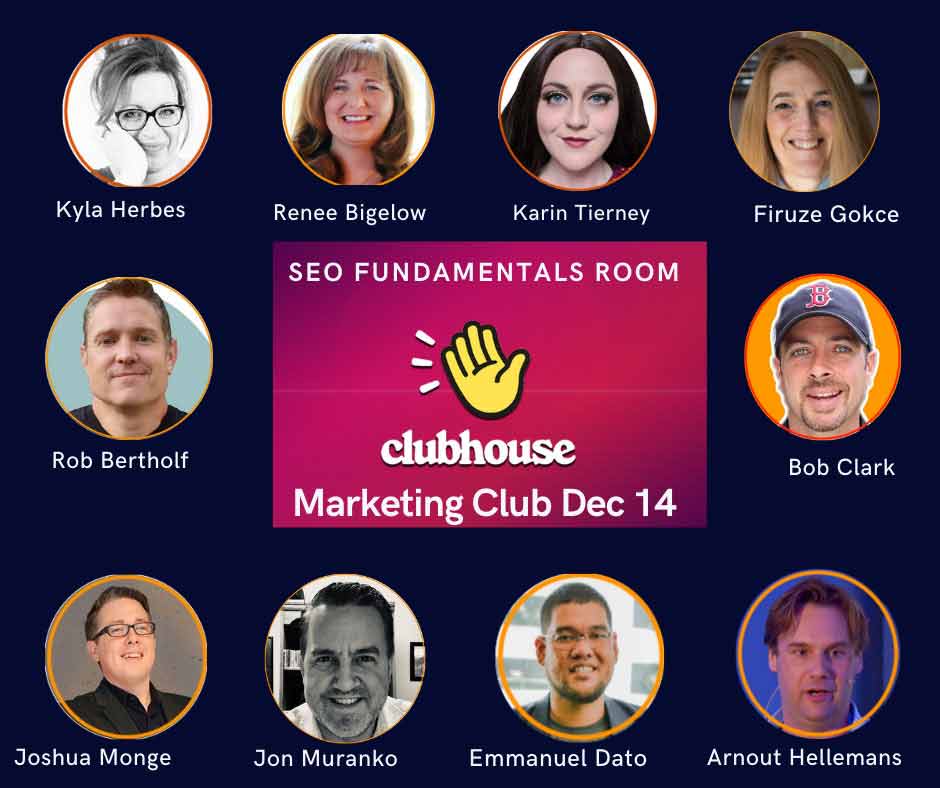
Event – Room Information
Marketing Club: The largest Marketing Club in ClubHouse
Every Tuesday at 8 am Pacific Time
https://www.clubhouse.com/event/PQ48lGnw
Date: Dec 14, 2021
Theme: SEO Fundamentals
Next Chat: Every Tuesday at 8 am PST
Moderators:
Rob Bertholf https://rob.bertholf.com/
Joshua Monge: https://waymakerseo.com/
Bob Clark: https://misspepper.ai
Itamar Blauer: https://www.curemedia.com/
Karin Tierney: https://alzina.marketing/
Kyla Herbes: https://houseofhipsters.com/